Controls on every screen.
Mute, Hindi or English, and Replay, always in the same place. In V5 the mute icon got a written label, because an icon alone wasn’t enough.

FREED · 2026 · PM + product designer
People were cancelling their debt programme soon after signing up. I designed a guide that talks them through it, in Hindi or English, before asking for anything.
Scroll · the guide is playing on the phone
What I owned
Built with an engineering team, an analytics lead and my manager, who reviewed each BRD and readout.
How I worked · FREED waives its onboarding fee for a few days each month. I used every window as a test slot.
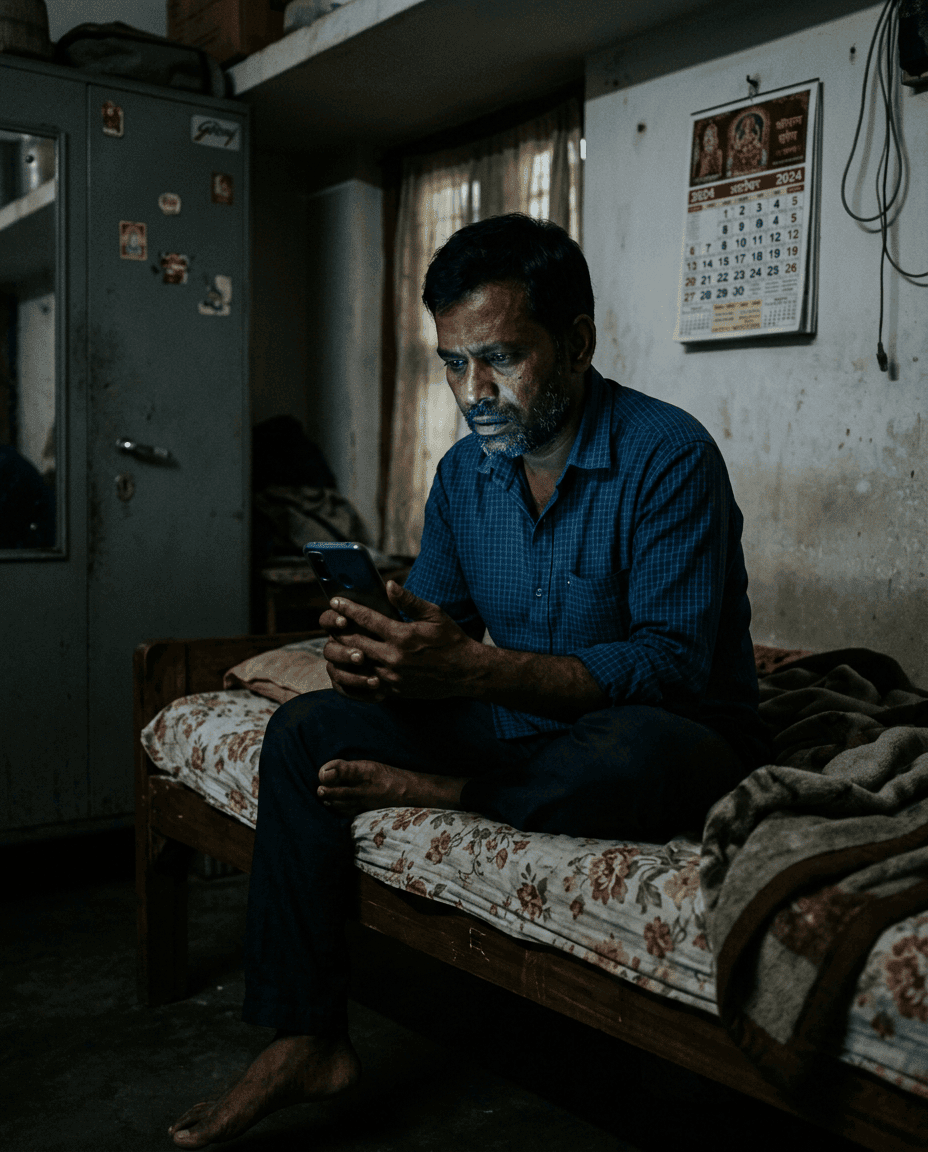
Who this is for
Many FREED members come to the programme already struggling: calls from lenders, a low-end Android phone, a plan written in English. That’s who had to understand the programme before saying yes.
01 · The problem
FREED settles loans for less. Members save every month, and FREED negotiates with each lender. But many signed up without understanding how it worked, often reading in their second language, on a low-end Android phone.
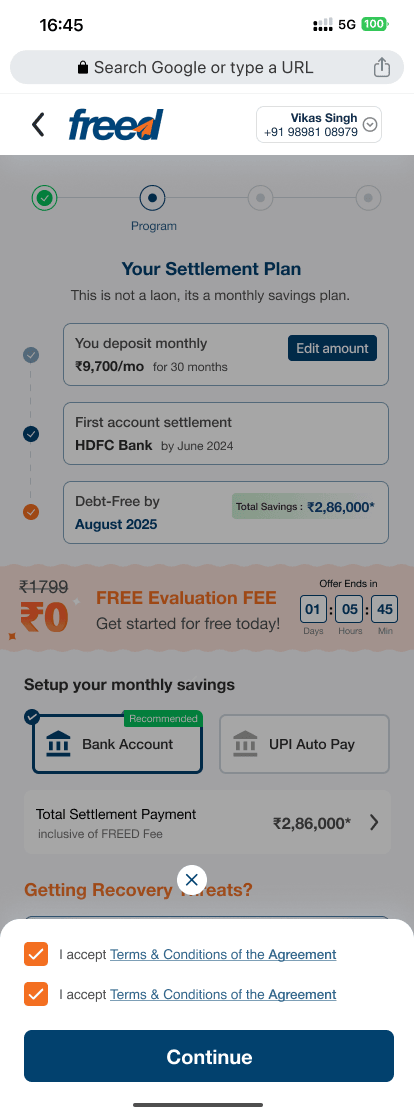
02 · The bet
If people understand the programme before they commit, the ones who stay will be the ones who meant to.
No walls of terms. Each screen explains one thing, then waits.
A voice reads every screen, with Replay, so reading isn't required.
Hindi or English, switchable on every screen without starting over.
Every extra question lost about one person in ten. So: a click budget of three.
The core idea
One idea per screen, read aloud in Hindi or English, with Replay. Reading becomes optional. Understanding doesn’t.

The same moment, before and after
03 · The design
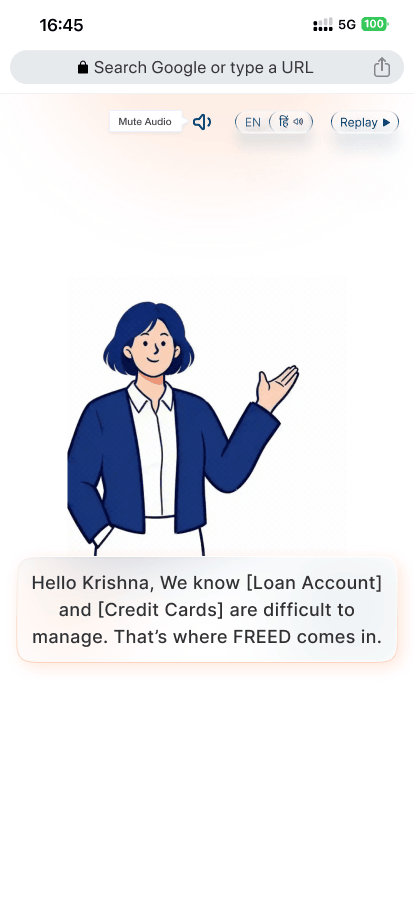
Every version started as a script, not a screen. I wrote it in Hinglish, branching on what each person already knew, and drew every Yes and No in FigJam before designing anything.
This is the real V1 script. Try it.
Hinglish lines are the real script. The English beneath is a translation for this page.
Drawn first

Structure before screens
V3 in lo-fi: the credit report, one Yes/No question, a Yes path and a No path, then one agreement that leads to auto-save.

The details
Mute, Hindi or English, and Replay, always in the same place. In V5 the mute icon got a written label, because an icon alone wasn’t enough.
She animates only while she’s speaking, then holds still, so movement always means “listen now”.
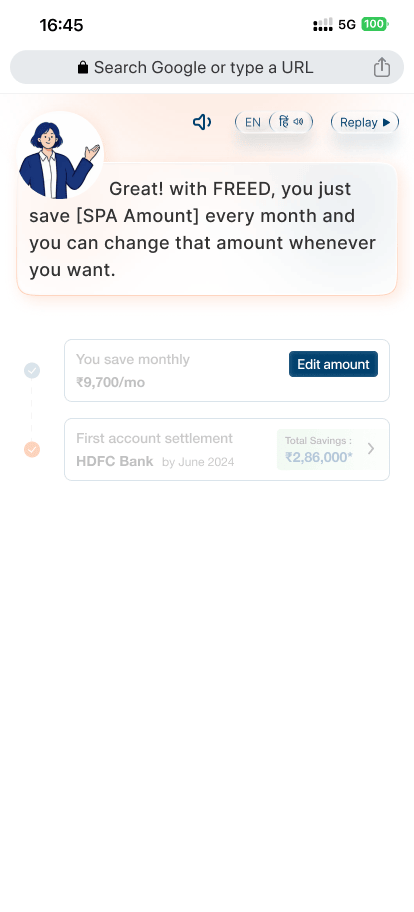
The plan lost its third step in V3. The monthly amount stays editable, right where it’s explained.
Buttons appear only when the audio ends, so nobody taps past the explanation.
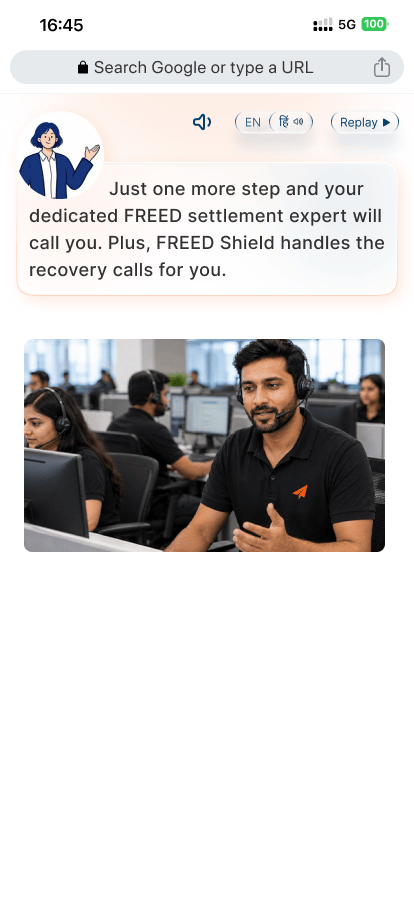
“Your dedicated FREED settlement expert will call you.” A person, at the moment money is about to move.
Yes or No, then I Agree & Continue. Everything else, like this explanation, plays on its own.
04 · See and hear it
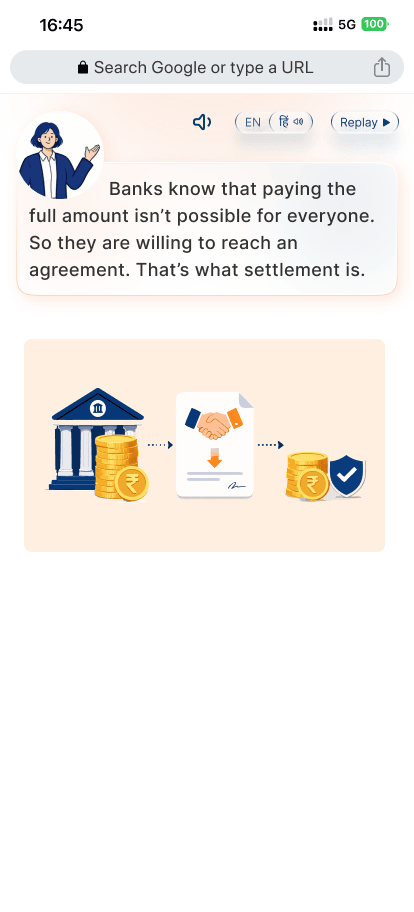
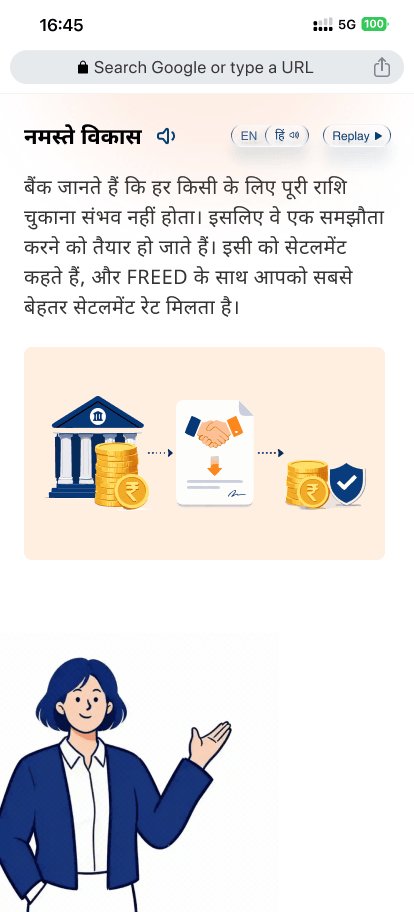
The guide greets the member by name, speaks their own numbers, and explains one idea per screen before asking for anything. English captions are on.
05 · The setback
By V2.1, with over 3,000 people in the guided group, cancellations were falling. But fewer people were signing up at all. Judged on sign-ups alone, the project would have been killed here.
06 · The turn
Instead of guessing, I broke the funnel down step by step. The guided flow kept up until people saw their plan. Between seeing the plan and signing the agreement, it lost them.
Share of sign-ups reaching each step, V2.1 test window (7,685 original, 3,172 guided). From FREED's database.
V3 replaced the agreement pop-up with one line on the plan screen, cut the plan from three steps to two, and made Hindi the default.
For the first time, more people reached the agreement in the guided flow than in the original, and cancellations fell from 25.4% to 19.7% (p ≈ 0.02).
07 · Five versions in four months

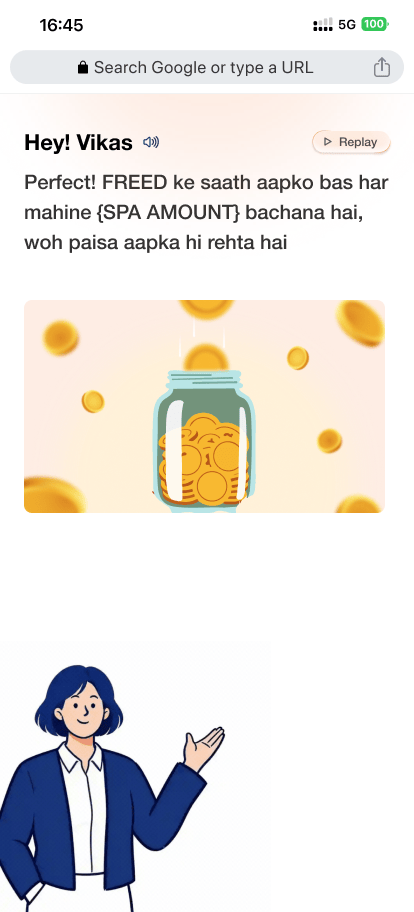 V2
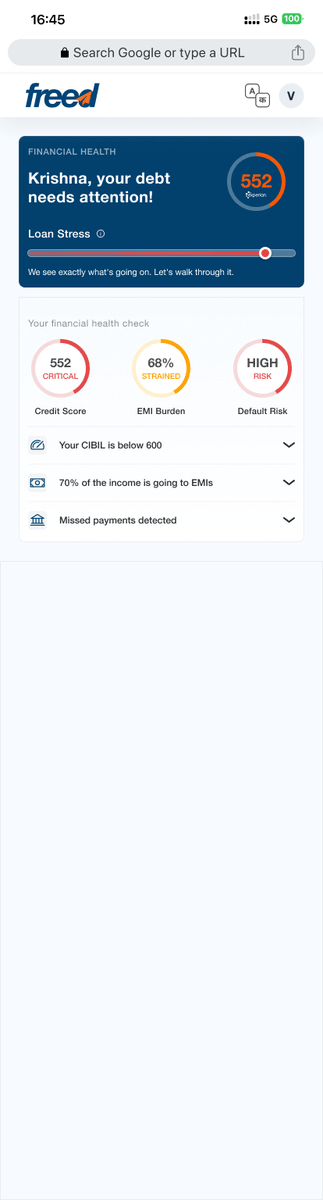 V2.1
 V3
 V4V5
What didn't work
Net retention stayed level at 24.6% in both groups. The explanation alone wasn't enough.
Cancellations fell, but fewer people signed up. The funnel showed me exactly where.
Moving the auto-debit out of the guide cost too many sign-ups. I rolled it back in V5.
Rolled back08 · Under the hood

I set up the voice system myself: three separate voice accounts, so one product can't use up another's credits, with automatic failover.
Static, personalised and fallback, in Hindi and English.
hindi_mandate_3a.mp3
Under the provider's limit of 15, with a queue so nothing is dropped.
If a name, amount or clip fails, a fallback line plays and the flow carries on.
Every tap carries its language and experiment arm, so every number splits cleanly.
Written, reviewed and shipped: V1 to V5, plus a vernacular BRD.
In V3 I found about 60% of experiment records had the wrong user ID, because users were enrolled before sign-up finished. The V3.1 BRD moved enrolment after segmentation, so only eligible people were counted.
09 · What the calls told us
of the people who still dropped off told us, in their own words, that they understood the programme. We called about 48 people who dropped off from the early versions; roughly a third couldn't be reached.

From the team's call log of guided-flow drop-offs. Notes are paraphrased; no names, numbers or IDs are shown.
10 · The outcome
Different closing scripts for new, moderate and critical cohorts, based on credit score and days past due.
More languages, starting with the ones our callers heard: Tamil, Telugu, Kannada, Marathi, Malayalam.
Answer the fear the calls surfaced: what settlement means for getting a loan later.
Fix the measurement before the first test. I only found the bucketing error at V3, so the early readouts were shakier than they should have been.
Watch conversion and cancellations together from day one. V2.1 surprised me because I was looking at one number.
Photographs of people and rooms on this page are AI-generated illustrations, made for this portfolio. Every screen, number and quote is real.
About these numbers: test windows only, from FREED's database, pulled 16 Nov 2026. V1 and V2 were small and mostly later-stage members, so they're directional. V5 is the youngest cohort. No rupee values or personal data are shown.